Godot 4.7.1 p0033 published Forward+ verified on hardware WebGPU beta
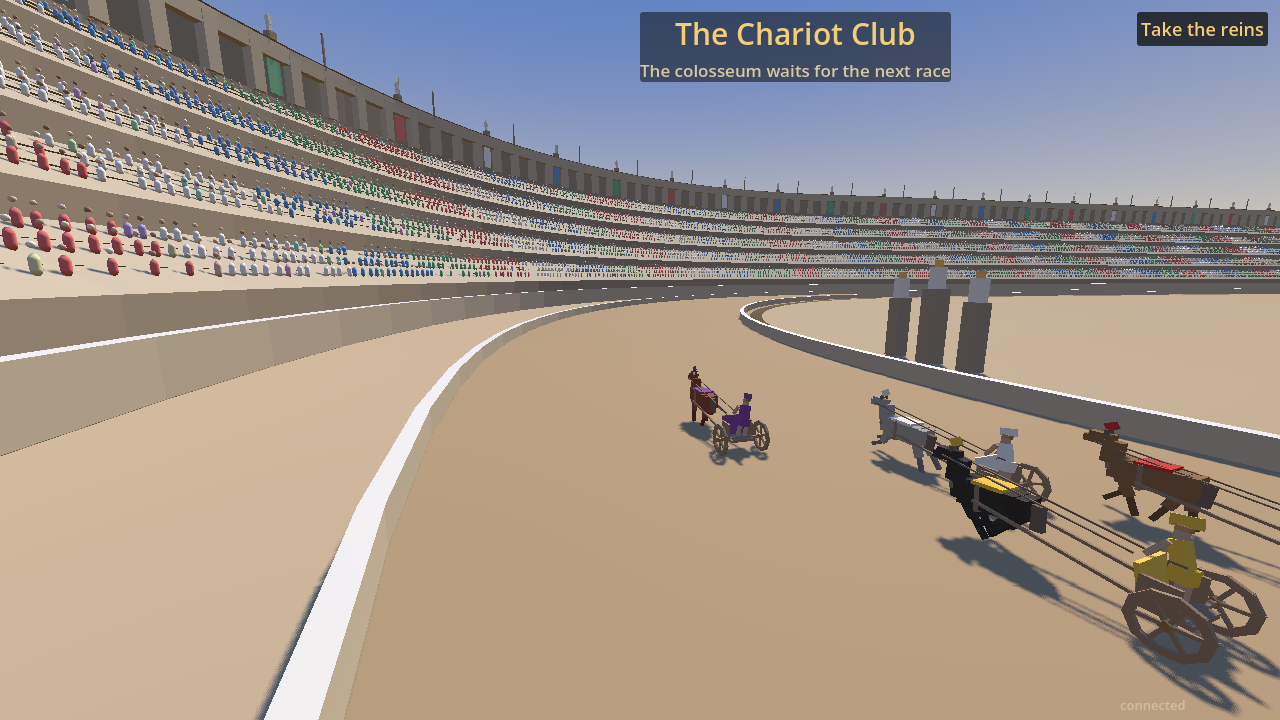
Godot's Forward+ renderer, running in a browser through WebGPU.
The initial backend lineage is David Walter's MIT-licensed dwalter/godotwebgpu work. Studio Foundation maintains the Godot 4.7.1 port, scoped patches, renderer fixes, build/export tooling, validation, release evidence, MCP tooling, and AI-native distribution layer. Official Godot remains upstream.
Run and inspect
WebGPU support: checking…
Enter the colosseum Minimal showcase Repository p0033 templates Runtime statusThe live demos on this page still serve the earlier p0014 Forward Mobile build — a Forward+ rebuild of the demo has not been deployed yet. The p0033 release templates render Forward+, verified on hardware (below). Initial load downloads a ~45.8 MB wasm (~12.0 MB over GitHub Pages gzip); in the recorded 12 Mbps p0014 run, frames appeared around 13 seconds and pipeline construction occupied about 2 seconds of engine startup.
Published releases and current main
| State | Patches | Renderer | Artifacts | Hardware status |
|---|---|---|---|---|
Published godot-4.7.1-webgpu-p0033 (current) |
0001–0033 |
WebGPU Forward+ (clustered); Forward Mobile selectable | Release/debug downloads available | First verified Forward+ frame 2026-07-28, NVIDIA Tesla P40, headed Chrome/WebGPU: 59 fps, 188 objects / 2,015,266 primitives, 0 invalid commandEncoder.finish out of 10,842, 0 rejected queue.submit, 0 bind-group failure classes. Three validation errors remain outside the presented-frame path. |
Published godot-4.7.1-webgpu-p0014 (historical) |
0001–0014 |
WebGPU Forward Mobile | Release/debug downloads available; the live demos on this page still serve this build | Minimal scene and three game scenes rendered on an NVIDIA Tesla P40 with 0 GPUValidationError |
Current main |
0001–0033 |
Forward+ renders; Mobile remains the export default | p0033 matches the locked series | Verified on one GPU (Tesla P40), one browser, one OS. AMD, Intel, Apple, Safari and iOS are unverified — run the probe and send the evidence file. |
Patches 0015–0033 are what made the clustered renderer work on hardware; they are in the p0033 downloads, not in p0014. Verification so far is one scene class on one machine — independent confirmations on other hardware are the most useful contribution right now.
What the evidence proves
- Official Godot 4.7.1 commit
a13da4feb8d8aefc283c3763d33a2f170a18d541is the base. - The p0033 archives use the checksum-locked patch range
0001–0033and render Forward+ — the clustered desktop path — on hardware (Tesla P40, headed Chrome/WebGPU, 59 fps, 0 rejected command buffers). - The live demo on this page is the earlier p0014 build: checksum-locked range
0001–0014, Forward Mobile, 60 fps at ~489–631 draws and ~23M primitives/frame with 0 validation errors on the recorded P40 run. - The browser probe observes an active WebGPU canvas context and rejects WebGL/WebGL 2 requests.
WebGPU support is beta. Safari/iOS, native mobile devices, and non-NVIDIA GPU vendors remain unverified. The p0014 Jolt web build also has a known concave-collider regression documented in the runtime status notes.
Reproduce it
The engine integration, minimal scene, and Chariot source are available in
the repository. Chariot is public for reproducibility but remains all
rights reserved under games/LICENSE.
Download both p0033 templates, verify their SHA-256 values from the
release notes, and export with just export-browser-webgpu.
That command applies the WebGPU shell handoff the official editor cannot
emit for these templates. Then just verify-renderer
--renderer forward_plus exports, serves, probes and traces the
build and writes one evidence file — it exits 0 only when a non-fallback
adapter, varied composited pixels, and engine draw counters all agree.
AI-native positioning
“AI-native” describes how Studio Foundation is operated: an MCP server, agent workflows, Blender asset tooling, and public validation commands. It is separate from the renderer claims above, which are scoped to named artifacts, hardware, scenes, and measured caveats.